
Heard on The Street: Quantitative Questions from Wall Street Job Interviews by Timothy Falcon Crack has been one of the most widely recommended books for quant interview preparation for over two decades. In this article we go over the key chapters (and what you can safely skip), evaluate whether the book covers all you need, show you the most effective way to use it for interview prep, and offer an alternative if you're in a rush.
What are the Key Chapters (& What to Skip)?
The book covers the following chapters:
- Purely Quantitative & Logic Questions
- Derivatives Questions
- Other Financial Economics Questions
- Statistics Questions
So if you're low on time, what are the key chapters to cover to maximise your chances of acing the interview? Our assessment is as follows:

The most useful section by far is the Statistics Questions - as its probability brainteasers appear year after year on everything from quant interviews at investment banks to trading gigs at prop shops.
Purely Quantitative & Logic Questions come in second place, as pure brainteasers are slightly less common than probability questions, but you still encounter them quite a bit - so don't skip this chapter. The rest is optional if you're short on time.
Non-Quantitative Questions is often overlooked: candidates spend way more time preparing for the technical part than the "soft" questions. But almost every interview will start with these, and interviewers can place great importance on your answers to them. It's also your chance to win them over with personality, so it's well worth thinking ahead about the answers you might give.
Derivative Questions mostly covers options math, and is typically relevant if you're interviewing for an options desk at a bank, or an options-focused trading firm like All Options. Even then it typically suffices to know the basics about The Greeks and high-level on Black Scholes (e.g. its assumptions, limitations etc.).
Lastly, Other Financial Economics Questions test your understanding of some common financial products and theories. This can be useful if you're applying for a trading role at an investment bank, but apart from that interviewers typically prefer to test your math skills and teach you what you need from finance on the job.
Does Heard on The Street Cover Everything You Need for an Interview?
While the book is comprehensive, it misses a number of important topics often tested in interviews. While its Statistics Questions chapter is excellent, you should supplement it with more practice in combinatorics, Markov Chains and strategy games. Further, modern-day quant finance interviews can include a number of other assessments:
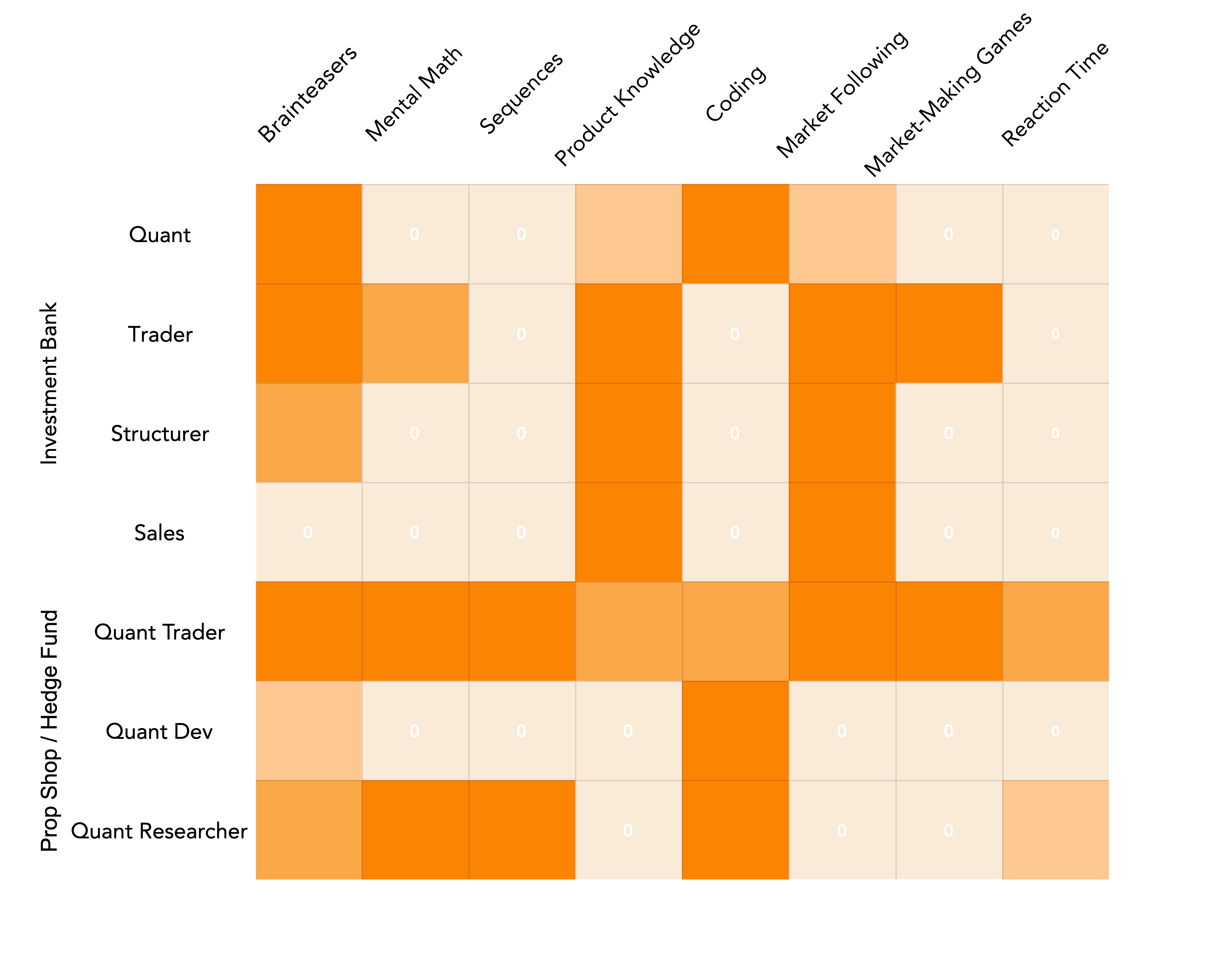
Tests like mental math and sequence recognition are now essential parts of interview processes at top firms like Optiver, and the book doesn't cover these at all. You'll need to supplement with dedicated practice for those.
How to Prepare for Interviews Using Heard on The Street?
There are two ways to go about it, depending on how much time you have. If you're in a rush, and you have a week to prepare, the goal is volume. Just see as many questions and solutions as you can, in the hope that you're asked something similar or related. Don't get stuck trying to solve each question on your own - they take a while to crack if you've never seen the trick before. And if you spend all your time going deep on a few problems, you can miss important topics and tricks.
It's a better risk-return strategy to spend a little time on a lot of problems, and try to memorise the approach. First evaluate how much time you have to prep until your interview, and pick the chapters of the book you're willing to cover. Check the "What are the Key Chapters (& What to Skip)?" section above for the key chapters. Then, divide your total prep time until the interview by the number of questions - this is how much time you should spend on every question. Be ruthless with this - resist the urge to dive too deep as you won't have time to cover everything. Read the question and make sure to understand what it's asking. Think briefly which approach you'd take to tackle it. Then immediately go to the solution, and try to understand the reasoning. Remember the approach - from which angle are they attacking the problem?
Ideally, you'd also try to find past interview questions asked at the firm you're interviewing with - they have a limited set of questions they ask, so you drastically increase your chances if you practice on those. There's a number of question banks online for different companies, you can check out our brainteasers page.
If you're starting your prep early (e.g. few months ahead of your interviews), you want to try and learn the problem-solving tricks. Go through each question, try to solve it for up to 1h. Once 1 hour is up, or you've solved the question - check the solution, and try to remember the trick used.
Typically this is some sort of a change in perspective, an angle from which you attack the problem. For instance, it's often helpful to try and solve the problem with a small number of iterations / participants, find the principle and then extrapolate to the more complex case you're asked about - the induction trick. Or, you might need to draw a probability tree to find the expected value of some process.
Problem-Solving Tricks
There is a fixed set of problem-solving tricks that appear over and over, year after year in quant finance interviews. If you learn to recognise and use them, you can typically crack 99% of interview questions. We've gone over hundreds of brainteasers and synthesised them into 12 repeatable tricks. We've distilled them into a 7-day guide which teaches the tricks, when to use them, and applies them to real interview questions from recent interviews:
- Day 1: Combinatorics & Trees
- Day 2: Symmetry, Induction & Fixing
- Day 3: Strategy Games
- Day 4: Markov Chains
- Day 5: Conditionals & Complements
- Day 6: Number Theory
- Day 7: Common Tricks & Fermi
We've built this for the panicked candidate who just got an interview invite and has a week to prepare. It teaches you how to think about problems, not just what the answer is. This is the best shot we can give you at acing your interview in 7 days.
FAQ
Where Can I Find the Heard on The Street PDF?
There is no official free PDF released by the author.
You may find unofficial copies circulating online, but the book is officially available through Amazon.
How Does Heard on The Street Compare With The Green Book?
In Heard on The Street, solutions are in the back of the book, so it's less practical to work with, and the explanations can be a bit drawn out. The Green Book covers more of what you need (e.g. stochastic calculus & Markov Chains), but practical guide has a better stats brainteasers section - which is a key one.
Which Roles Is the Book Most Relevant For?
The book focuses heavily on probability and general brainteasers, which are most commonly asked in trading and quant interviews at prop shops. That said, these firms tend to also assess mental math, sequence recognition etc. Make sure you supplement your preparation with other resources for these.
Does the Book Match the Difficulty of Real Interviews?
Yes, particularly the Statistics Questions chapter. Smaller firms sometimes even ask questions directly from the book, or their close variations. Larger firms like Jane Street typically make up their own questions, so it's worth looking at the firm's actual recent interview questions. You can find these on platforms like Glassdoor, or dedicated question banks for your company, e.g. Optiver Playlist, Goldman Sachs Playlist, Jane Street Playlist...
Good luck preparing for your interviews!