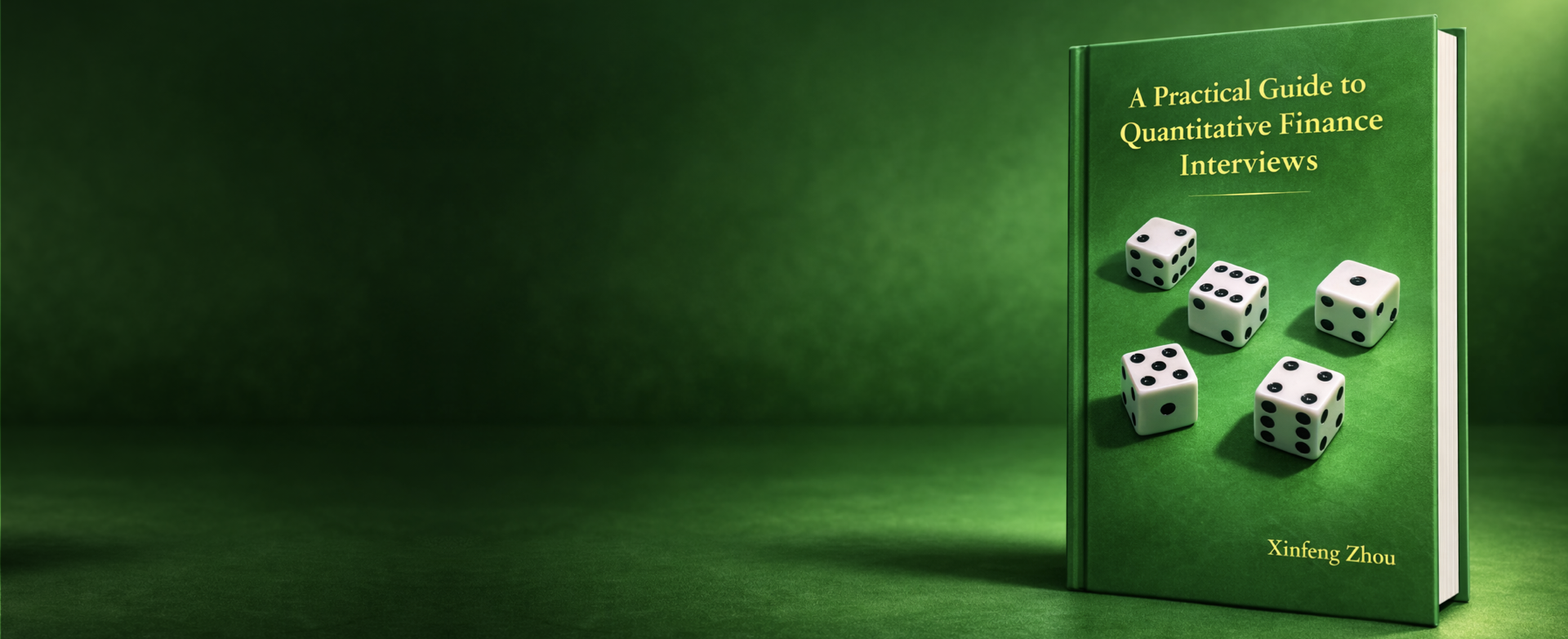
A Practical Guide to Quantitative Finance Interviews by Xinfeng Zhou, otherwise known as The Green Book, is considered the holy grail of quant finance interview prep. First published in 2008, it has been used by thousands of candidates and interviewers alike, and is widely recommended as one of the top resources to prepare for quantitative trading and quant researcher interviews. But if you just got invited to a technical interview, you have a week to prepare and don't feel ready, you'd better be sure you're using the right resource to not blow your chance.
In this review, we break down the key chapters, what you can safely skip, whether the book is still relevant in 2026, and what alternatives exist if you're short on time.
Key Chapters & What to Skip
A Practical Guide to Quantitative Finance Interviews is very broad. It is divided into 7 sections, covering everything from linear algebra and probability, to stochastic calculus and option greeks.
Reality is, if you have a week or two to prep for your technical interview, it's not realistic to cover the whole thing. So here are the most important chapters and sub-chapters to cover, depending on the role you applied for:
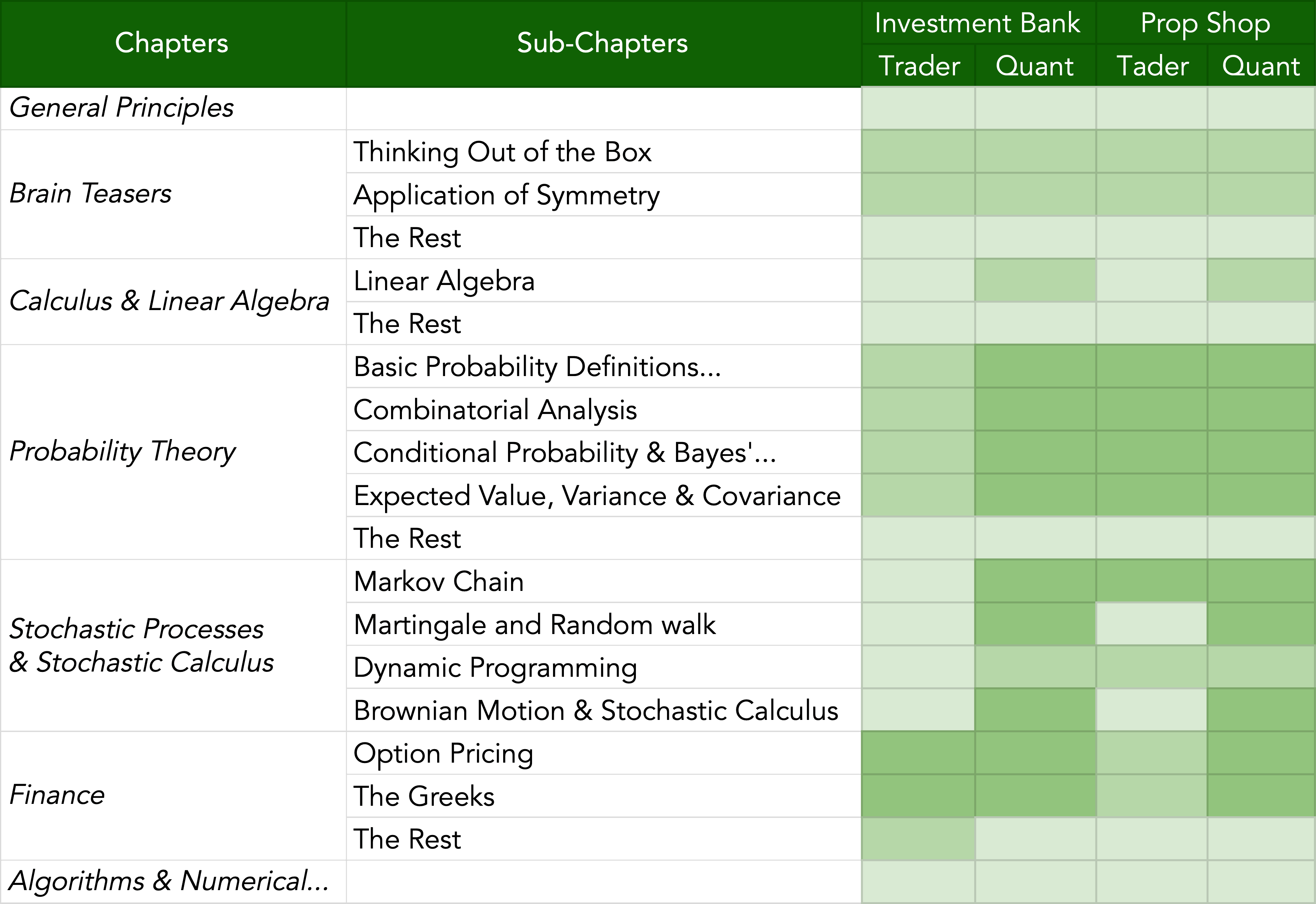
The darker the green, the more important the chapter is for your role. Pick the column that best matches your situation, depending on the role and company you're applying for.
For quant trading roles at firms Jane Street, Citadel, and IMC, focus heavily on the probability chapter and markov chains. For trader roles at investment banks like Goldman Sachs or JP Morgan, it's important to master product knowledge and market-making games, which are not fully covered in the book. For quant and researcher roles at both prop shops and banks, make sure to include topics like stochastic calculus and statistics.
Is A Practical Guide to Quantitative Finance Interviews Still Relevant in 2026?
Short answer: the principles — yes, the questions — less so.
Xinfeng Zhou's book covers most topics you would need for the brainteasers part of a quant interview. The probability section in particular remains timeless — the same types of problems keep appearing in interviews year after year. However, interviews these days tend to be broader than what the book covers. Here are all the tests you might see in a modern-day quant finance interview:
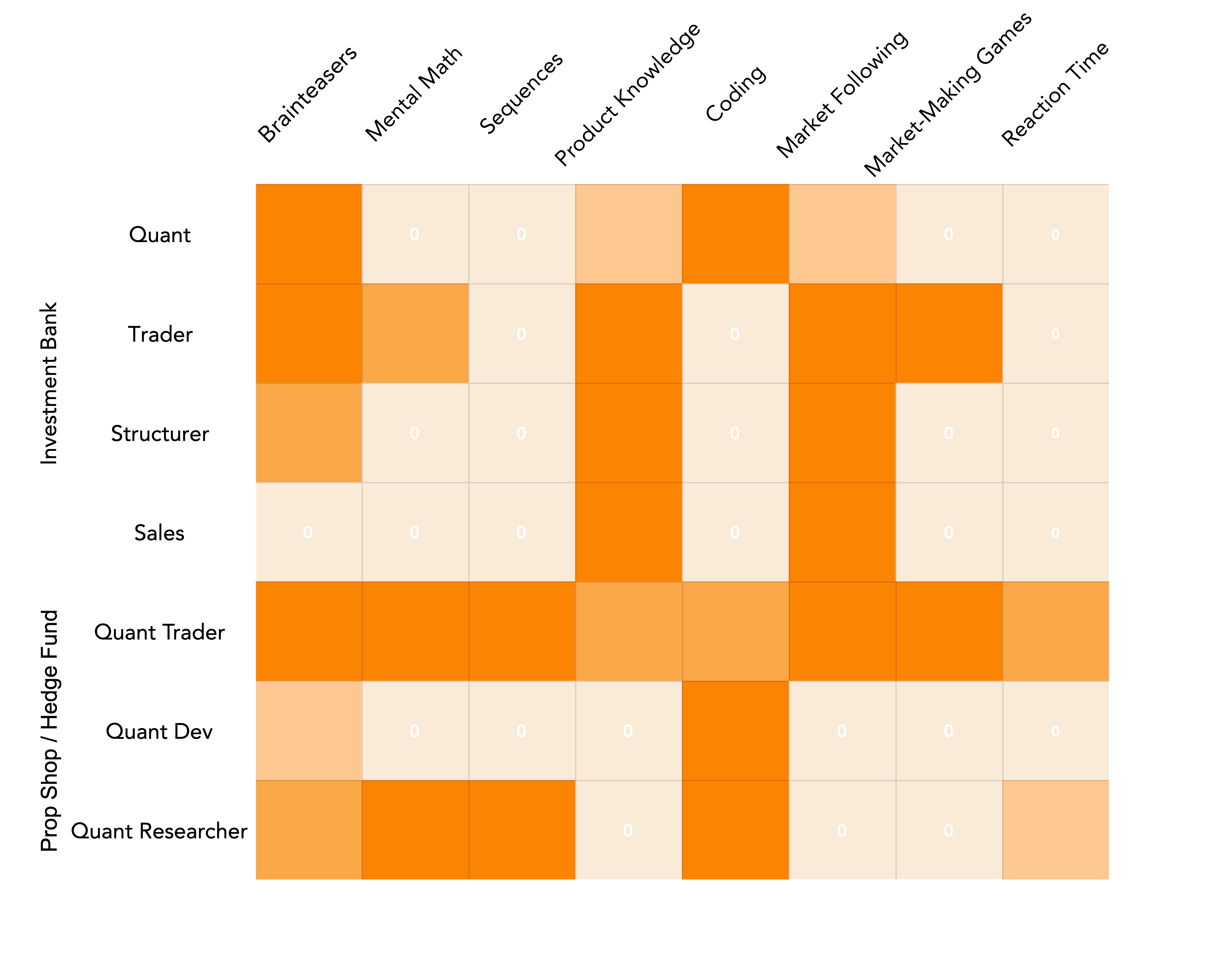
Tests like mental math and sequence recognition are now essential parts of interview processes at top firms like Optiver, and the Green Book doesn't cover these at all. You'll need to supplement with dedicated practice for those.
Do the Questions Reflect the Difficulty of Real Interviews?
Generally, they do. Some smaller firms might actually ask questions directly from the book, although more established ones will create their own questions — knowing that candidates prepare using the Green Book.
The difficulty level in the book is a good match for most mid-tier firms. However, the questions start to get more difficult with top players like Jane Street and Optiver. For these firms, it's worth checking their actual past interview questions to gauge the difficulty level (you can check out Jane Street 7-Day Playlist).
One thing to note: the book presents solutions, but doesn't teach you a systematic method for arriving at those solutions. This means you might read a solution and understand it, but struggle to reproduce that thinking under interview pressure. This is a common frustration among candidates.
Limitations — If You're Short on Time
The biggest limitation of the book comes if you don't have much time to prepare. Here are the main drawbacks:
- Not targeted to specific companies — the questions are generic, not always tailored to what firms actually ask.
- Too broad to cover in 1-2 weeks — with seven sections spanning hundreds of pages, you'll need to be very selective
- No systematic problem-solving framework — you learn by seeing solutions many times over, not by learning repeatable techniques, which is not ideal if you're under time pressure
- Missing modern test formats — no coverage of mental math speed tests, sequence recognition, or market-making simulations
- Questions may be outdated — top firms know candidates use this book and have moved to original questions
Most people find they can't solve the questions on the first try. You learn by repetition, and you might not have time for that.
All in all, if you have the time and are starting your interview prep months in advance, the Green Book is a solid resource — just ensure you supplement it with other resources for things like mental math and sequences tests. If you're short on time, the book might not be your best bet.
7-Day Action Plan
If you are short on time, you might want to try our 12 Tricks to Crack Any Brainteaser 7-day course. The first two days are free and no log-in is required. We built it for the panicked candidate who just got an interview invite and has a week to prepare. It distills the core patterns into 12 repeatable tricks that cover 99% of brainteaser questions:
- Day 1: Combinatorics & Trees
- Day 2: Symmetry, Induction & Fixing
- Day 3: Strategy Games
- Day 4: Markov Chains
- Day 5: Conditionals & Complements
- Day 6: Number Theory
- Day 7: Common Tricks & Fermi
Each section presents the theory from first principles (assuming no prior knowledge), and then applies it to real questions asked in recent interviews at firms like Jane Street, Goldman Sachs and Optiver. It teaches you how to think about problems, not just what the answer is. This is the best shot we can give you at acing your interview in 7 days.
Frequently Asked Questions
Where can I find the Practical Guide to Quantitative Finance Interviews PDF?
The book is available for purchase on Amazon. Xinfeng Zhou has not released an official free PDF. You may find unofficial PDFs circulating online, but we recommend purchasing the book to support the author — it's well worth the investment if you have time to work through it.
How Does The Green Book Compare to Heard on the Street?
Another popular book for quant interview prep is Heard on the Street by Timothy Falcon Crack. Here's how they compare:
- Scope: The Green Book is broader, covering more advanced topics like stochastic calculus and Markov Chains. Heard on the Street focuses more on brainteasers and probability.
- Difficulty: The Green Book ramps up to harder questions. Heard on the Street stays more consistently at a mid-level difficulty.
- Best for: If you're applying for a quant role, the Green Book's broader scope is more useful. For pure trading roles, either book works well for the brainteaser component.
Many candidates use both books in combination — but if you only have time for one, the Green Book edges ahead for its broader coverage.
Who is Xinfeng Zhou?
Xinfeng Zhou is a quant who wrote A Practical Guide to Quantitative Finance Interviews based on his own experience interviewing at and working for quantitative finance firms. The book draws from real interview questions he encountered and collected over the years.
Which roles is the Green Book best for?
The book is most useful for quant researcher roles at prop shops and quant roles at investment banks. It covers the mathematical foundations and brainteasers that these roles test for. For quant developer roles, you'll need additional coding prep. For trader roles at banks, you'll need more product-specific knowledge, and for traders at prop shops, you'll need to practice mental math and sequence tests.
Is the Green Book enough on its own?
For most candidates, no. You'll want to supplement it with practice on mental math, sequence tests, and company-specific question sets. The book is an excellent foundation, but modern quant interviews test a wider range of skills than what it covers.
Good luck preparing for your interviews!